
Pay to Pick Up Trash: A Crazy Idea That Might Actually Work
1. The Idea
My girlfriend is playing a video game called Coral Island. It is mostly farming and foraging: planting crops, gathering things, living quietly on a tropical island, doing favors for the villagers, and exploring new places. In short, it is the kind of life one imagines for oneself around the third week of January. But one part in particular caught my attention. Her character puts on scuba gear, dives to the sea floor, and, among many other things, cleans up trash.
I was watching her tidy the ocean floor from the comfort of our sofa, and something clicked in my brain. I wondered: what if it weren’t virtual?
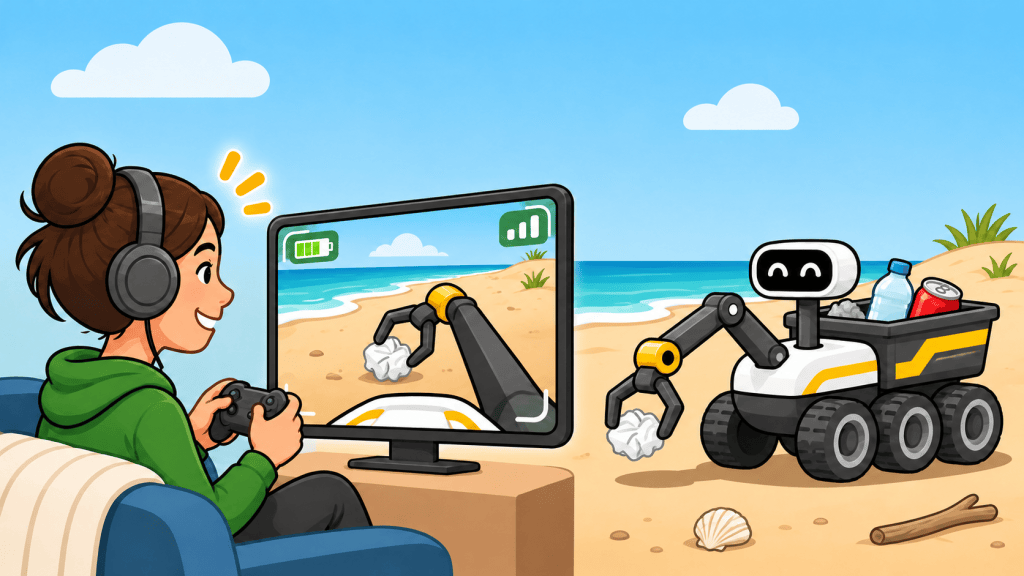
What if, instead of picking up virtual trash in a virtual world, she could still lie there on our couch, snacks within reach, and pick up trash on a beach in California? Or Indonesia? I pictured her remotely driving a robotic vehicle, the view on the screen coming from its cameras, working its arms to pick up the litter. It is a rare and precious thing to find a hobby that improves the planet while requiring no pants.
It was a compelling idea, so my mind started running off with it, as minds do. I already have too many sustainability projects in the works (my to-do list has begun to resemble a hostage situation), so I’m not going to build this. I am hoping someone hears or reads this and takes up the challenge.
2. Why This Works
Let’s start with the psychology.
Cleaning is satisfying. People find it deeply gratifying to watch a mess become clean, and there is an entire category of video games built on the pleasure. Anyone who has lost an afternoon to PowerWash Simulator knows this perfectly well. You point a pressure washer at a filthy surface, the grime disappears, and millions of people pay good money to do exactly that. It’s probably one of the most honest forms of therapy available on Steam.
House Flipper takes it a step further. You walk into a trashed, abandoned house, haul out the junk, scrub it, renovate it, and transform it. That before-and-after arc is a big part of the reward, and the main reason many people play. And then there is Coral Island‘s underwater cleanup, where the prize is a cleaner reef. A cleaned-up trail or shoreline offers the same arc, with the small advantage that it is real!
Volunteering has a barrier. You have to physically show up. Compare that with how we usually handle real-world cleanup. We either pay people to do it, or we ask them to give up a Saturday, drive somewhere, and pick up other people’s trash. Some people love this. Many more would like to but can’t. If you have a disability, two jobs, small children, or you live on the wrong continent, you are shut out.
People feel helpless. A great many people who care about the environment feel they can do nothing. They want to do something concrete, and a screen full of likes is not it. For most, the options are picking up a little litter nearby, donating, or simply feeling bad, which is the only one of the three that requires no effort and is therefore enormously popular. A concrete, visible, hands-on action that makes a difference across the world is a very different option. It might just be the antidote to both the malaise of climate helplessness and the trash littering our environment.
After I had the idea, I explained it to my girlfriend and asked, “Would you enjoy doing that for real, remotely, on a real beach?” She gave a very enthusiastic yes. I know I would do it too, and I don’t even care for the sort of video games she does — proof that the idea reaches beyond the usual suspects. I also asked a few other people I know who are interested in the environment, and every one of them said they would love doing that. That is only a handful of people, and I am not pretending it is market research. (Market research involves a spreadsheet, and I have only enthusiasm and a girlfriend.) But it is an idea worth following.
3. The Idea, Plainly Explained
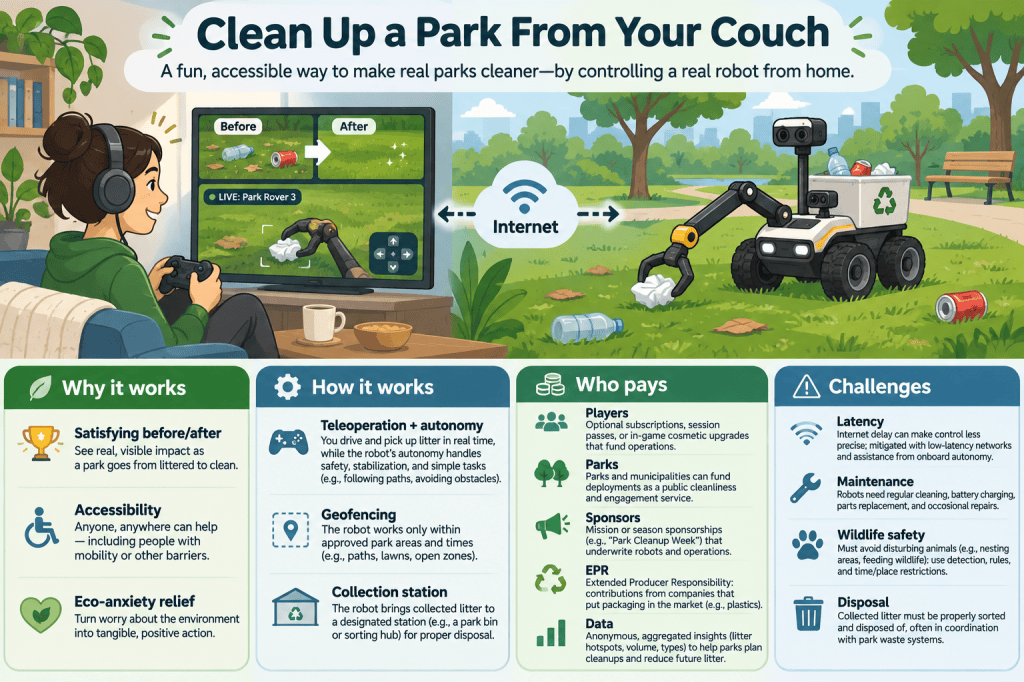
Here is the concept. Picture a small remote-controlled vehicle, a rugged little truck with cameras and a manipulator arm or two. It has a truck bed, or perhaps pulls a small trailer. You are at home, looking through its cameras. You spot a bottle half-buried in the dirt, steer over, grab it with the arms, and drop it in the bed. When the bed or trailer is full, the vehicle drives to a collection station, something like a dumpster, unloads or swaps for an empty trailer, and heads back out for more. It’s kind of a Roomba with ambition, a job, and a commute.
The vehicles run on solar power, through charging stations, panels on the vehicle itself, or both. They connect over the internet, and with satellite internet so widely available now, even the most remote locations are probably within reach.
To pilot the idea, you would start small: a few vehicles and one collection station at one heavily littered site.
Now for the key reframe. Instead of paying people to clean up, let people pay for the privilege and satisfaction of cleaning up. Notice what that says about the setup. The player is not the product, and neither is their labor. The player is the customer, and the product is the experience: the satisfaction of cleaning, the thrill of winning, and the knowledge that real trash is really leaving a real place. Instead of paying or persuading people to do an unpleasant job, you give them a satisfying one they can do from home, and they will not only do it willingly, they’ll even pay to do it.
Why keep a human in the loop at all? Because trash is messy, and robots still struggle with it. It is half-buried, tangled, crushed, faded, and camouflaged by leaves, as though it had been trained by a spy agency. Teaching a machine to identify and grab every variety of litter is genuinely hard, but humans are very good at it. So the player makes the choose-and-grab decision, which turns the hardest technical problem into the fun part of the game.
One more thing, and it is important: this is not meant to replace paid cleanup crews. It adds capacity and funding in places that had neither. A park with a tight budget and a growing litter problem gets help it could not otherwise afford — the robot equivalent of a friend who shows up with a truck when you move.
4. This Isn’t Science Fiction
You might be thinking this sounds far-fetched, but it really isn’t, because all of the pieces already exist separately — which is how many good ideas look in retrospect, like they were obvious all along.
Telepresence robots, which are controlled remotely over the internet, are already routine in mining, agriculture, bomb disposal, and even surgery. If we trust a remote hand with a scalpel, a bottle cap should not pose much of a challenge. There are beach-cleaning machines, robotic boats and surface drones that skim trash from harbors and rivers, and, as previously mentioned, satellite internet now reaches most of the planet. If you can order groceries from a mountaintop, you can drive a robot from your living room.
What is missing is the combination of these technologies with a crowd of willing participants. Hardware people have been building machines to clean up litter, game people have been building engagement loops, and this idea sits squarely between them, like a mutual friend at a party who has finally gotten two people to stop avoiding each other.
Two things make the moment right. First, people are comfortable with remote experiences in a way they were not a decade ago. (Many of us have conducted entire careers from the waist up.) And second, extended producer responsibility laws, which make packaging companies answer for what happens to their products after sale, are creating real demand for credible cleanup programs. In other words, the law is doing some of the marketing for us.
If someone is already doing something like this, I would genuinely love to hear about it.
5. Beyond the Beach
I have been talking about beaches because they are the glamorous starting point: the image, the emotion, the instant appeal. But the idea is not limited to beaches, nor even to coasts. Any natural area with a litter problem fits: a forest trail, a mountain pullout, a desert wash where people dump things, a riverbank, a lakeshore, a prairie, a national or state park, a trailhead, a roadside, an urban green space. Anywhere trash accumulates, which is to say, anywhere humans have been.
Different terrain calls for different machines. A rugged tracked or wheeled rover suits trails and flats, a little boat can skim a lake or harbor, a shallow-water submersible can handle a reef or lake bed, and flying drones can reach steep slopes and canyons where wheels cannot.
Now a practical point for anyone piloting this. Beaches are great for image and popularity, but they are among the worst places for hardware. Sand gets in everything, salt corrodes everything, water kills electronics, and heat cooks batteries. A beach, as a venue for delicate machinery, is roughly the equivalent of holding a black-tie dinner on a trampoline. So if I were advising someone building this, I would not say “start on a beach.” I would say start where the machines will survive and a partner is eager: a flat park area, a dry riverbank, a city park trail. Prove the technology, work out the kinks, build the community, and only then bring it to the beach as the flagship. You don’t need to start with the hardest environment. Builders, consider this your hall pass to start somewhere easier.
6. The Ripple Effects
Besides the main benefit of cleaning up our natural areas, the side benefits are almost as interesting — the part of the idea where it stops being a gadget and starts being a platform.
Data. Every item picked up could be logged: what it was, what brand, where it was found, and when. Over time that becomes a continuous, location-specific litter dataset that researchers, regulators, and packaging producers would all value. (Nothing concentrates the corporate mind like seeing one’s own logo in a photograph of a drainage ditch.) If this becomes common, over the years it could reveal trends in litter and identify targets for continuous improvement. A longer-term idea: additional cameras could be added to the vehicles to log wildlife census data in the places frequented by both humans and wildlife.
People. Accessibility: this offers a way to participate for those with mobility limitations who cannot physically clean a trail. Education: imagine a classroom of children in one country taking turns driving robotic vehicles to clean a real park in another, learning geography, ecology, stewardship for places they may never visit, and even empathy for the people who live there. It is a rare field trip that comes with a robot but no bus. And then there is relief from eco-anxiety, because the caring finally has a concrete action attached to it.
Places. Every site will need local people to maintain the machines, empty the stations, and rescue stuck rovers, and that is local work, the kind that can’t be outsourced to a couch. A community that hosts one can build real pride, an adopt-a-park feeling, and possibly a tourism boost from having cleaner natural areas. Companies could use it for team-building and sustainability programs that are far more engaging than simply writing a check, and considerably more memorable than a trust fall.
7. Who Pays?
An idea like this only survives if it can pay for itself, so let’s talk money — the section where every dream meets its accountant.
Players. Pay-per-session, monthly subscriptions, and gift sessions for friends and family. Schools could hold subscriptions that different classes can share. Companies wanting to meet sustainability goals could buy ongoing subscriptions and run challenges or incentives for their employees to participate.
Governments and park agencies. Cities, states, provinces, and parks might sponsor a setup simply to get their natural spaces cleaned, which adds capacity without hiring a full crew and earns some welcome publicity. I suspect this is the steady, reliable foundation of the business. A large park could have a setup that rotates through its popular areas in turn. A city could have one that makes the rounds of all its small parks, like a very polite street sweeper with a fan club.
Companies. Brand sponsorship and corporate team events. For packaging producers, whose extended producer responsibility rules require them to help pay for cleaning up their waste, this could be one visible, measurable way to meet those obligations. Guilt, it turns out, is a business model.
Data licensing. The litter data stream could be made available to researchers, agencies, and companies. Trash, monetized — the circle of life.
Media. Streamers running cleanup marathons, a 24-hour charity cleanup stream, charity livestream events, branded content, sponsored events, and more. Twenty-four hours of people picking up other people’s litter — reality television finally doing something useful.
If it works, the expansion path is natural: boats, shallow submersibles, drones, and river robots that catch plastic before it reaches the sea.
8. The Honest Part: Challenges
I don’t want to oversell this, so let’s talk about the questions that need answers and the challenges that need to be met. Every idea looks marvelous by candlelight, but in the light of day is where we find the stains.
Technical. Internet delay and dropouts are real. Across the world there is lag, so the robot probably needs to handle navigation and safety on its own while the human decides where to go, what to grab, and how to grab it. The environment is hard on machines: sand, salt, mud, dust, heat. And the big one is making the grabbing arms feel fun and natural to use. That is a game design problem as much as an engineering one, because if controlling the arm is clumsy, it stops being fun and starts being frustrating. Nobody has ever paid a monthly fee to be irritated by a claw.
Practical. Vehicles get stuck, flip, or break, so every site needs a local human team for service, maintenance, and management. Somewhere, a very patient person will be retrieving a robot from a ditch for the seventh time that day, and they deserve a raise.
Safety and regulation. Protect wildlife by keeping machines away from nesting areas and sensitive habitats, and steer clear of any hikers, swimmers, or pets who happen to be around. Permits will have to be obtained and camera privacy ensured. Hazardous litter like needles will need to go into a special hazardous-materials container on the vehicle if possible, or, failing that, be tagged for a human to come deal with. In short, some trash stays in the “professionals only” category.
Misuse. Guardrails should be built into the system, not left to rules. Think geofencing, speed limits, limited arm strength, and full logging. The internet, after all, has never once been given a toy and used it responsibly.
Economics. Honestly, a robot driven by a stranger won’t be nearly as fast as a paid crew, but that is not the point. A paid crew needs a funding source before it can even start, and this model brings its own. Players, sponsors, and producer-responsibility money primarily pay for the cleanup. The question isn’t whether robots beat a paid crew on cost per pound. It is whether the cleanup can happen at all in places with little to no budget for it. The real goal is to make the experience engaging enough that the funding keeps coming.
Retention. We all know that novelty fades almost as quickly as most New Year’s resolutions, so to keep players you need progression, goals, and community with features like leaderboards, team challenges, and visible before-and-after progress.
Disposal. Pickup is only half the story. Where the trash goes afterward matters just as much. Collected litter still has to be sorted and recycled or landfilled properly, so every site needs a disposal partner in place before the first robot rolls.
9. Who Should Run With This?
This is the part I care about most, because I am not going to build this. So let me speak directly to some of you — the casting call.
- Robotics and hardware startups: you get a use case with built-in demand and a story people care about.
- Game developers and studios: you understand engagement loops, and the hardest part of this idea isn’t the hardware. It is making it feel good to play. That is your specialty.
- Municipalities, park agencies, and port authorities: you could host a pilot. You have the site, the permits, and the problem. (The problem, at least, is not in short supply.)
- Conservation NGOs: you already have cleanup programs, the volunteers, the credibility, and often the grant access.
- Corporate sustainability teams and packaging producers: this is a more engaging and measurable program than a donation — a sustainability report with a joystick.
- Satellite and connectivity companies: this is a showcase for what your network makes possible. Consider it a very photogenic demonstration.
- Universities and research labs: there is rich work here, from the data to human-robot collaboration at a distance.
A starting recipe: one permitted, hardware-friendly site. A hybrid design in which the robot handles navigation and safety and the human handles the pick decisions. And a partnership between a hardware team, a game designer, and a local government. That is a pilot.
10. Close
So, back to where we started.
Picture someone on a couch, hands on the controls, watching a camera feed from a trail on the other side of the world. They spot a bottle half-buried in the dirt, maneuver the arm, grab it, and drop it in the bed. Somewhere, a pile in a collection station grows, data gets logged of the material and location, and a place gets a little cleaner. And it’s real.
We have made environmental cleanup depend on two things: being physically there, and volunteering or being paid to do it. This idea says neither has to be true. Some people will happily pay for the chance to make a real difference in a place they have never seen — which is either a beautiful statement about human nature or a very clever business model, and honestly, it’s both.
If you build robots, make games, manage public lands, or fund cleanups, I hope this idea becomes yours. And if someone comes to mind while you’re reading, send them this article. And if you do end up building it, I would not only love to hear about it, I would love to take a turn driving!
Thanks for reading.
© Copyright 2026 by Eric Sparks


Leave a Reply